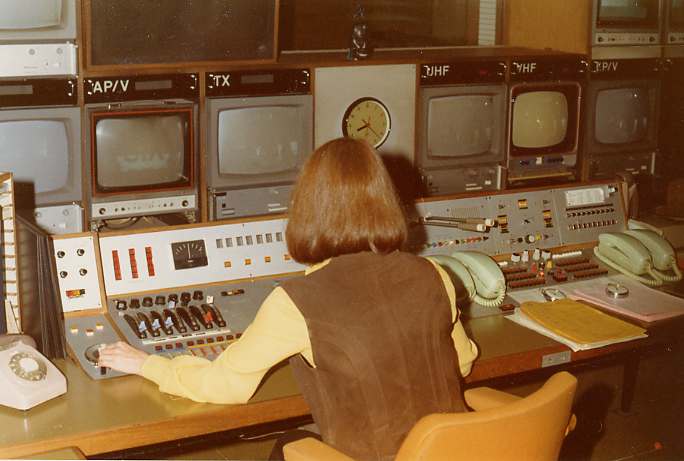
A shot of the MCR at ATV Centre, with Assistant Transmission Controller Anna McKenna, from the mid 70s. Note the two screens monitoring the separate UHF and VHF outputs.

Insider Interview - Andy Martin (Part 2)
Promotion SlidesPromotion slides consisted of a picture relating to a programme together with its day of transmission and start time. The slides, Andy says, had different variations, captioned differently. One would say the day and time of broadcast (eg. "Tuesday 10.30"), another would say "Tomorrow 10.30" and a third "Today 10.30". The slides that were in use were kept in the control room, and the library would bring the relevant programmes slides to the control room a week in advance of broadcast. There are many more examples of ATV promotion slides on this site. The "Routine Sheets" for each day would say when the slides were to be used. Routine SheetsThe ITV network's programmes were scheduled from programme planning meetings in London, and this information was passed onto the various presentation departments in the form of a Daily Programme Schedule (DPS). Using this information, the Transmission Controllers would work out all the timings exactly (eg. how long each programme was, advertisement breaks, time available for the announcers etc.) and these timings, along with which other companies the programme were networked to, would comprise a Routine Sheet. For controlling the output, the Transmission Controllers worked from the Routine Sheets. Andy continues: "Routine Sheets were made up the day before transmission and then distributed around the technical areas. On the day the Transmission Controller would then use that as his source of information, for controlling the output. I was the Transmission Controller on that first day in Paradise! ['Paradise Centre' was another name for ATV Centre in Broad Street.] However, I remember letting Dave Simmons, who was the most senior TC at the time, actually put the station on the air that day and then I took over." In 1959, a red phone system was installed around the ITV network for communicating emergencies, such as newsflashes or programme underruns and overruns. The red phone became used on a daily basis for checking through each company's Routine Sheets. At 11am each morning, a nominated contractor (which was Thames and LWT) would ring the red phone three times (to distinguish it from an emergency). The Transmission Controller on duty from each company would take the call, and the nominated contractor would call a 'register' to ensure all companies were present (ie. each company's name was read out and the TC would acknowledge that he/she was on the line). In the event of a newsflash, ITN would ring the nominated contractor who would then inform the other Transmission Controllers. Each individual TC would decide (perhaps with advice from the Programme Controller) whether to take the newsflash for immediate broadcast, record it for transmission during the next break, or not to take the bulletin at all. If an interval became necessary, then the TC would run downstairs to the library to pick appropriate slides and music! If the Routine Sheets were deviated from because of an emergency, then an Irregularity Report had to be completed, which described why the routine sheet wasn't followed, for example a commercial was dropped or a programme over or underran. The staff at the transmitters also had copies of the Routine Sheets. The test cards and tuning signals were radiated by the transmitters, not by the ITV companies, and the Routine Sheet for the day would tell the transmitter staff when to fade the test card to black and switch in the ITV company broadcasting on the transmitter. The station start-up sequences and programmes afterwards were originated by the companies. ATV's Amateur Radio ClubQSL cards are exchanged by amateur radio users who have picked up a transmission from each another. |